
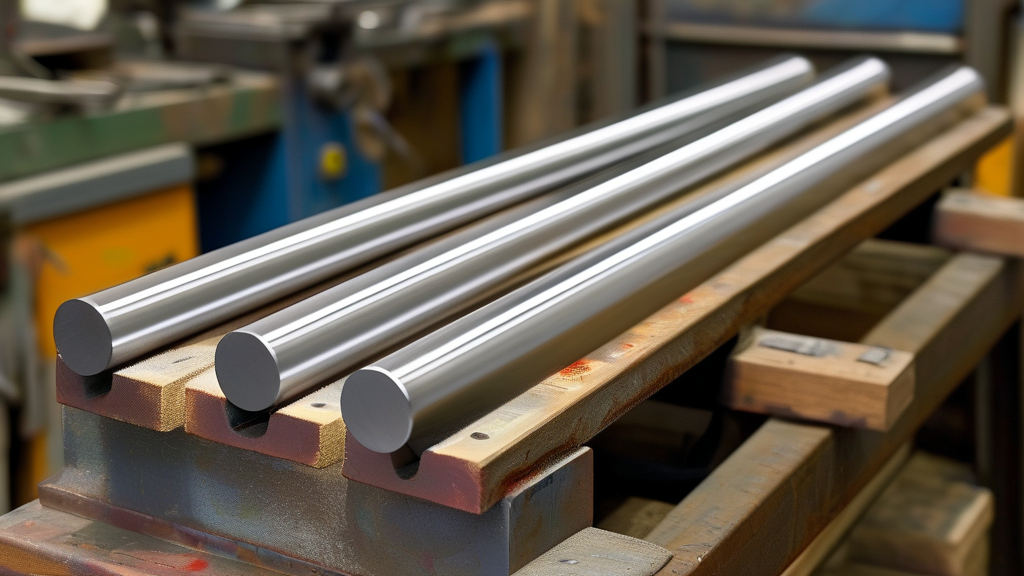
Introduction to 17-4 PH Stainless Steel Round Bar
What Is 17-4 PH Stainless Steel?
17-4 PH (Precipitation Hardening) stainless steel is a martensitic, chromium-nickel-copper alloy renowned for its high strength, excellent corrosion resistance, and good machinability. The designation “17-4” refers to its composition: approximately 17% chromium and 4% nickel. This alloy is widely used in aerospace, chemical processing, oil and gas, and medical industries due to its ability to achieve high mechanical properties through heat treatment. For a deeper understanding of stainless steel classifications, refer to the Stainless steel Wikipedia page.

Common Applications of 17-4 PH Round Bar
The round bar form of 17-4 PH is particularly valued in applications requiring precision, durability, and resistance to stress corrosion cracking. Typical uses include valve stems, pump shafts, fasteners, turbine blades, and structural components in high-stress environments. Its versatility makes it a preferred material in both static and dynamic load-bearing systems.
Chemical Composition and Key Properties
Elemental Breakdown of 17-4 PH Stainless Steel
The performance of 17-4 PH is directly tied to its precise chemical composition. The primary elements include:
- Chromium (15.0–17.5%): Provides corrosion resistance and oxidation protection.
- Nickel (3.0–5.0%): Stabilizes the martensitic structure and enhances toughness.
- Copper (3.0–5.0%): Critical for precipitation hardening.
- Niobium (0.15–0.45%): Stabilizes carbon and improves strength.
- Carbon (≤0.07%): Kept low to maintain weldability and corrosion resistance.
- Manganese, Silicon, Phosphorus, and Sulfur: Present in trace amounts to control processing and mechanical behavior.
This composition enables the alloy to respond effectively to heat treatment, a hallmark of precipitation hardening stainless steels.
Physical and Mechanical Properties at Room Temperature
In the solution-annealed (Condition A) state, 17-4 PH exhibits moderate strength (UTS ~110–130 ksi) and good ductility. However, its true value emerges after aging. Key baseline properties include:
- Density: ~7.8 g/cm³
- Melting point: ~1400–1450°C
- Thermal conductivity: ~18 W/m·K
- Electrical resistivity: ~800 nΩ·m
- Modulus of elasticity: ~196 GPa
These properties make it suitable for high-performance engineering applications where weight, thermal stability, and electrical resistance are considerations.
Heat Treatment Conditions and Their Impact on Strength
Overview of Standard Aging Conditions (H900, H1025, H1150, etc.)
The strength of 17-4 PH round bar is primarily controlled through precipitation hardening (aging) after solution annealing. The most common conditions are defined by the aging temperature and resulting mechanical properties:
- H900 (482°C/900°F, 1 hour): Highest strength (UTS ~190 ksi, yield strength ~170 ksi), but reduced toughness and ductility. Ideal for high-stress, low-impact applications.
- H1025 (552°C/1025°F, 4 hours): Balanced strength (UTS ~155 ksi) and toughness. Widely used in aerospace and defense.
- H1150 (621°C/1150°F, 4 hours): Lower strength (UTS ~135 ksi) but improved ductility and stress corrosion resistance. Suitable for marine and chemical environments.
- H1150M (621°C/1150°F, 4 hours + 566°C/1050°F, 4 hours): Enhanced toughness and fracture resistance, used in critical structural components.
Each condition is standardized under ASTM A564 and AMS 5643, ensuring consistency across suppliers.
Microstructural Changes During Aging
During aging, fine copper-rich precipitates (ε-phase) form within the martensitic matrix, impeding dislocation movement and increasing strength. The size, distribution, and density of these precipitates are temperature- and time-dependent. Over-aging (e.g., above 650°C) leads to coarsening of precipitates and a decline in strength, while under-aging results in suboptimal hardening. This process is a classic example of precipitation hardening in metals.
Strength Characteristics Across Conditions
Tensile and Yield Strength by Condition
The mechanical performance of 17-4 PH round bar varies significantly with heat treatment:
| Condition | Tensile Strength (ksi) | Yield Strength (ksi) | Elongation (%) | Hardness (HRC) |
|---|---|---|---|---|
| H900 | 190 | 170 | 8 | 40–45 |
| H1025 | 155 | 145 | 10 | 35–38 |
| H1150 | 135 | 115 | 12 | 30–33 |
| H1150M | 130 | 105 | 14 | 28–31 |
These values are critical for design engineers selecting materials based on load requirements and safety factors.
Fatigue and Fracture Toughness Performance
17-4 PH exhibits excellent fatigue resistance, particularly in the H1025 and H1150 conditions. Fatigue strength can reach up to 70–80 ksi at 10⁷ cycles, depending on surface finish and loading conditions. Fracture toughness (KIc) ranges from 50 to 70 MPa√m, with higher values in over-aged conditions. This makes it suitable for cyclic loading applications such as landing gear and rotating machinery.
Machinability of 17-4 PH Stainless Round Bar
Machinability in Solution-Annealed (Condition A) State
In the as-supplied, solution-annealed (Condition A) state, 17-4 PH offers good machinability—comparable to 304 stainless steel. It can be turned, drilled, milled, and threaded using standard carbide or high-speed steel tools. Recommended cutting speeds range from 60–100 ft/min (18–30 m/min), with proper coolant use to prevent work hardening.
Challenges in Machining Aged Conditions
Machining after aging (e.g., H900) is significantly more difficult due to high hardness and work-hardening tendencies. The material becomes abrasive, leading to rapid tool wear. Best practices include:
- Using polycrystalline diamond (PCD) or ceramic inserts for finish turning.
- Employing high-pressure coolant to reduce heat and chip adhesion.
- Avoiding interrupted cuts to prevent tool chipping.
- Pre-machining in Condition A, followed by aging, is the preferred industry approach.
Surface Finish and Post-Machining Considerations
Achieving tight tolerances and smooth surface finishes (Ra < 1.6 µm) requires precision tooling and stable setups. Post-machining aging may cause slight dimensional changes (typically <0.001 in/in), so allowance for growth must be factored into design. Stress-relief annealing is not recommended, as it may alter the precipitation structure.
Corrosion Resistance and Environmental Performance
General Corrosion Behavior
17-4 PH offers good resistance to atmospheric corrosion, fresh water, and mild chemicals. However, it is less resistant than austenitic grades (e.g., 316L) in chloride-rich environments. Pitting and crevice corrosion can occur in marine or saltwater settings, especially in the H900 condition due to lower toughness.
Stress Corrosion Cracking (SCC) Resistance
SCC resistance improves with higher aging temperatures. The H1150 and H1150M conditions are preferred in environments with tensile stress and chlorides. For applications in aggressive media, protective coatings or cathodic protection may be necessary.
Selection Guidelines and Industry Best Practices
Matching Condition to Application Requirements
- High strength, low ductility needed? → H900
- Balanced strength and toughness? → H1025
- Corrosive environment or high toughness? → H1150 or H1150M
- Complex machining required? → Machine in Condition A, then age
Quality Assurance and Testing Standards
17-4 PH round bars must comply with ASTM A564, AMS 5643, and EN 10088-3. Routine testing includes:
- Tensile and hardness testing
- Microstructure evaluation
- Non-destructive testing (NDT) for internal defects
- Chemical analysis (OES or XRF)
Proper certification (e.g., 3.1 or 3.2 per EN 10204) ensures traceability and performance reliability.
Conclusion: Optimizing 17-4 PH for Performance and Reliability
17-4 PH stainless steel round bar stands out for its exceptional strength-to-weight ratio, tunable mechanical properties, and broad industrial applicability. By understanding the interplay between heat treatment conditions, strength, and machinability, engineers can optimize material selection for demanding environments. Whether used in aerospace actuators or offshore valve systems, proper processing and condition selection are paramount to long-term performance and safety.
Related Products and Next Steps
Use these links to compare options and send RFQ with complete specs.