
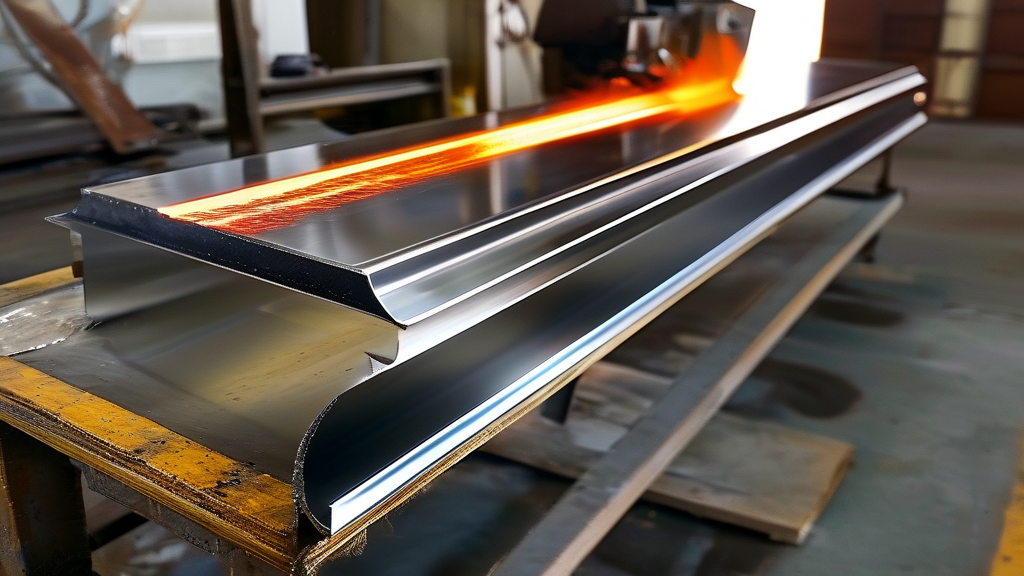
Introduction to 321 Stainless Steel Sheet in High-Temperature Applications
Defining High-Temperature Service in Industrial Context
High-temperature service refers to environments where materials are exposed to sustained temperatures above 500°C (932°F), often in oxidizing, carburizing, or cyclic thermal conditions. In such settings, material selection becomes critical due to risks of creep, oxidation, thermal fatigue, and intergranular corrosion. Stainless steels are frequently chosen for their balance of strength, corrosion resistance, and thermal stability. Among them, 321 stainless steel sheet stands out for specific high-temperature applications due to its unique alloying composition and performance characteristics.
Why 321 Stainless Steel? A Brief Overview
321 stainless steel is an austenitic chromium-nickel alloy stabilized with titanium (Ti), typically containing 17–19% chromium, 9–12% nickel, and 5×(C%)–0.70% titanium. The titanium addition is the key differentiator from 304 and 316 grades, providing resistance to intergranular corrosion after exposure to temperatures in the 425–815°C (800–1500°F) range—a phenomenon known as sensitization. This makes 321 stainless steel particularly suitable for prolonged high-temperature service where welding or thermal cycling is involved.
Key Properties of 321 Stainless Steel Sheet for High-Temperature Use
Titanium Stabilization and Resistance to Sensitization
The primary advantage of 321 stainless steel lies in its titanium stabilization. During welding or prolonged exposure to the sensitization range (425–815°C), chromium carbides can precipitate at grain boundaries in unstabilized grades like 304, depleting chromium locally and leading to intergranular attack. Titanium preferentially forms titanium carbides, preserving chromium at grain boundaries and maintaining corrosion resistance. This mechanism is well-documented in metallurgical literature and is a cornerstone of austenitic stainless steel design for high-temperature service.
Oxidation and Scaling Resistance
At elevated temperatures, stainless steels form a protective chromium oxide (Cr₂O₃) layer. 321 maintains this layer effectively up to approximately 870°C (1600°F) in continuous service and up to 925°C (1700°F) in intermittent conditions. The high chromium content (≥17%) ensures robust oxidation resistance, while the nickel content (≥9%) enhances ductility and thermal shock resistance. This makes 321 ideal for furnace components, exhaust systems, and heat exchangers.
Mechanical Strength and Creep Resistance
321 stainless steel retains good tensile and yield strength at elevated temperatures. Its creep resistance—critical in applications involving sustained loads at high temperatures—is superior to non-stabilized grades. For example, at 600°C, 321 maintains approximately 60% of its room-temperature yield strength, compared to lower retention in 304. This performance is essential in pressure vessels, boilers, and turbine components.
When to Choose 321 Over Other Stainless Steel Grades
321 vs. 304: The Sensitization Dilemma
While 304 stainless steel is cost-effective and widely used, it is prone to sensitization in the 425–815°C range. In applications involving post-weld heat treatment or cyclic heating (e.g., refinery piping, chemical reactors), 321 is the preferred choice. The titanium stabilization in 321 prevents chromium carbide formation, ensuring long-term structural integrity. For example, in welded assemblies exposed to high heat, 321 eliminates the need for post-weld annealing—a significant advantage in field installations.
321 vs. 316: When Corrosion Resistance Isn’t the Priority
316 stainless steel, with added molybdenum (2–3%), excels in chloride-rich or acidic environments (e.g., marine, chemical processing). However, molybdenum does not enhance high-temperature oxidation or creep resistance significantly. In high-temperature oxidizing environments—such as flue gas ducts or heat shields—321 outperforms 316 due to its superior thermal stability and lower cost. Choose 321 when high-temperature oxidation and intergranular corrosion resistance are paramount, and chloride exposure is minimal.
321 vs. 347: The Niobium Alternative
347 stainless steel uses niobium (columbium) for stabilization instead of titanium. While both grades resist sensitization, 347 offers slightly better high-temperature strength and creep resistance above 800°C. However, 321 is often preferred due to lower cost, better formability, and easier weldability. Titanium-stabilized 321 also avoids the potential for niobium segregation during casting, which can affect consistency in large-scale production. For most industrial applications below 870°C, 321 provides a more economical and reliable solution.
Common Applications of 321 Stainless Steel Sheet in High-Temperature Service
Aerospace and Jet Engine Components
321 is widely used in jet engine exhaust systems, afterburner components, and heat shields due to its ability to withstand repeated thermal cycling and high-velocity gas exposure. Its resistance to scaling and oxidation at temperatures up to 900°C makes it ideal for aerospace thermal management systems.
Petrochemical and Refinery Equipment
In refineries, 321 stainless steel sheets are used in catalytic reformer tubes, furnace linings, and high-temperature piping. These systems often operate in the sensitization range, making titanium stabilization essential. The material’s resistance to sulfur-containing atmospheres further enhances its suitability in hydrocarbon processing environments.
Power Generation and Boiler Systems
321 is employed in superheater tubes, economizers, and flue gas desulfurization (FGD) systems. Its creep resistance and oxidation stability ensure long service life under continuous high-temperature operation. In combined-cycle power plants, 321 components can last over 100,000 hours at 650°C.
Automotive and Exhaust Systems
High-performance and diesel exhaust systems use 321 stainless steel for manifolds, downpipes, and catalytic converter housings. The material resists thermal fatigue and oxidation, even under rapid temperature fluctuations. Its formability allows for complex shapes without cracking during fabrication.
Fabrication and Welding Considerations for 321 Stainless Steel Sheet
Welding Best Practices
321 is readily weldable using common processes: TIG (GTAW), MIG (GMAW), and resistance welding. Use matching filler metals (e.g., ER321 or ER347) to maintain corrosion resistance. Preheating is generally not required, but interpass temperature should be controlled to avoid excessive heat input, which can lead to distortion or reduced toughness.
Post-Weld Considerations
Unlike 304, 321 does not require post-weld annealing to prevent intergranular corrosion—thanks to titanium stabilization. However, for critical applications, a solution annealing treatment (1050–1100°C followed by rapid quenching) can optimize mechanical properties and ensure full stabilization.
Forming and Machining
321 exhibits good ductility and can be cold-formed into complex shapes. However, it work-hardens rapidly, so intermediate annealing may be needed for deep drawing or severe bending. Machining requires sharp tools, low speeds, and adequate coolant to manage heat buildup.
Limitations and When to Avoid 321 Stainless Steel
Performance Above 900°C
While 321 performs well up to 870°C continuously, its strength and oxidation resistance degrade above 900°C. For applications exceeding this threshold (e.g., furnace belts, radiant tubes), consider 310S or nickel-based alloys like Inconel 600.
Chloride and Acidic Environments
321 lacks molybdenum, making it vulnerable to pitting and crevice corrosion in chloride-rich environments (e.g., coastal installations, chemical tanks). In such cases, 316L or duplex stainless steels are more appropriate.
Cost-Benefit Analysis
321 is more expensive than 304 but less costly than 316 or 347. Evaluate lifecycle costs: while 321 may have a higher initial cost, its extended service life and reduced maintenance in high-temperature applications often justify the investment.
Conclusion: Strategic Selection of 321 Stainless Steel Sheet
Choosing 321 stainless steel sheet for high-temperature service is a strategic decision based on thermal stability, resistance to sensitization, and long-term reliability. It excels in oxidizing, cyclic, and welded environments where 304 fails and 316 is overqualified. By understanding its properties, limitations, and ideal applications—from aerospace to petrochemicals—engineers can optimize performance, safety, and cost-efficiency. When high-temperature integrity is non-negotiable, 321 is not just an option—it’s the expert’s choice.