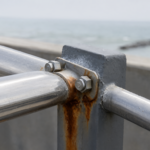
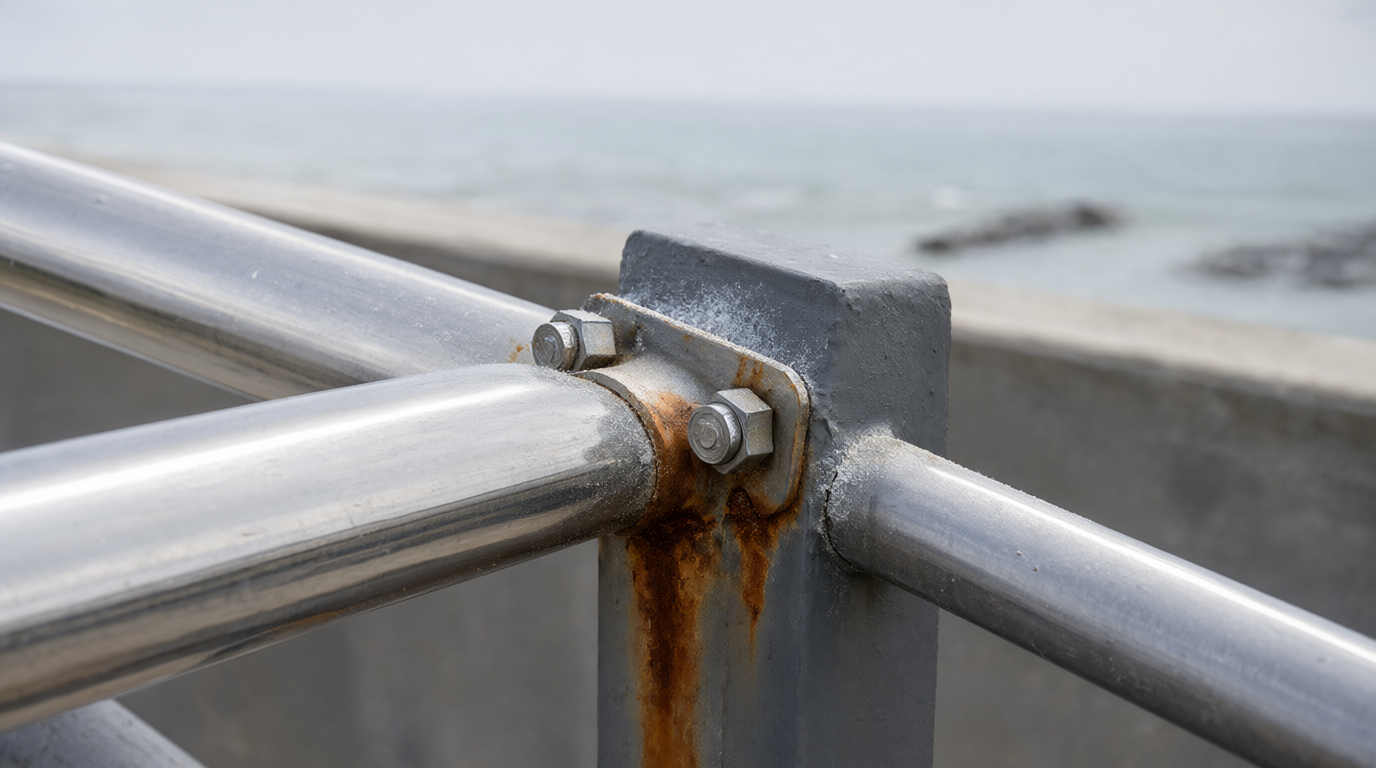
A stainless steel bolt threaded through a carbon steel bracket looks like a sensible, corrosion-resistant detail. Leave that assembly outdoors for a season or two, and rust may begin bleeding from the joint even though the stainless part itself is still perfectly clean. The carbon steel around the contact point is being consumed, and the stainless steel is quietly causing it.
This is galvanic corrosion, and it is one of the most common and most misdiagnosed problems in mixed-metal fabrication. This guide explains the mechanism in plain language, shows where it really appears on projects, and lists practical prevention steps you can specify at the design and fabrication stage.
What Is Galvanic Corrosion?
Galvanic corrosion is an electrochemical reaction that occurs when two different metals are in electrical contact in the presence of an electrolyte, such as moisture, salt spray, condensate or wash-down water. One metal becomes the anode and corrodes; the other becomes the cathode and is protected. The greater the difference in corrosion potential between the two metals, the stronger the driving force.
Stainless steel sits high on the galvanic series, meaning it is relatively noble or cathodic. Carbon steel sits much lower, meaning it is active or anodic. When the two touch in a wet environment, the carbon steel becomes the anode and gives up material. The stainless steel is largely unaffected, which is exactly why the damage is so often misread as bad stainless steel.
Why Stainless Steel and Carbon Steel Are a Difficult Pair
The problem is not that either material is poor. The problem is the gap between them. A wide potential difference paired with an electrolyte creates a small, efficient battery. Every time the joint gets wet and dries out, a little more of the carbon steel is lost.
The geometry of the joint usually makes it worse. When a small stainless fastener contacts a large carbon steel structure, the anode area is small and the cathode area is large. That unfavourable area ratio concentrates the corrosion current into a tiny zone and drives penetration quickly. This is why a single stainless bolt can create a deep pit in a heavy carbon steel member while the bolt head stays bright.
The Galvanic Series in Plain Language
The galvanic series ranks metals from noble (least likely to corrode, cathodic) to active (most likely to corrode, anodic). In a couple, the metal lower in the list sacrifices itself for the metal higher in the list.
| Material | Relative position | Behaviour in a couple with carbon steel |
|---|---|---|
| 316 / 316L stainless (passive) | Most noble | Protected; strongly drives corrosion of the partner |
| 304 / 304L stainless (passive) | Very noble | Protected; drives corrosion of the partner |
| Copper, brass, bronze | Noble | Protected; corrodes the partner |
| Lead, tin | Moderately noble | Mildly protected |
| Carbon steel, cast iron | Active | Becomes the anode and corrodes |
| Galvanized (zinc) steel | Active | Zinc sacrifices first, then steel |
| Aluminium alloys | Very active | Corrodes readily |
The larger the vertical distance between two materials in this list, the faster the reaction when moisture is present.
Where Galvanic Corrosion Appears on Real Projects
Coastal and marine structures
Salt spray is an excellent electrolyte. Stainless handrails bolted to carbon steel posts, stainless fittings on galvanized walkways, and stainless fasteners in painted steel frames all show accelerated attack at the coast. Rust staining appears at the joint within months.
Bolted connections in galvanized frameworks
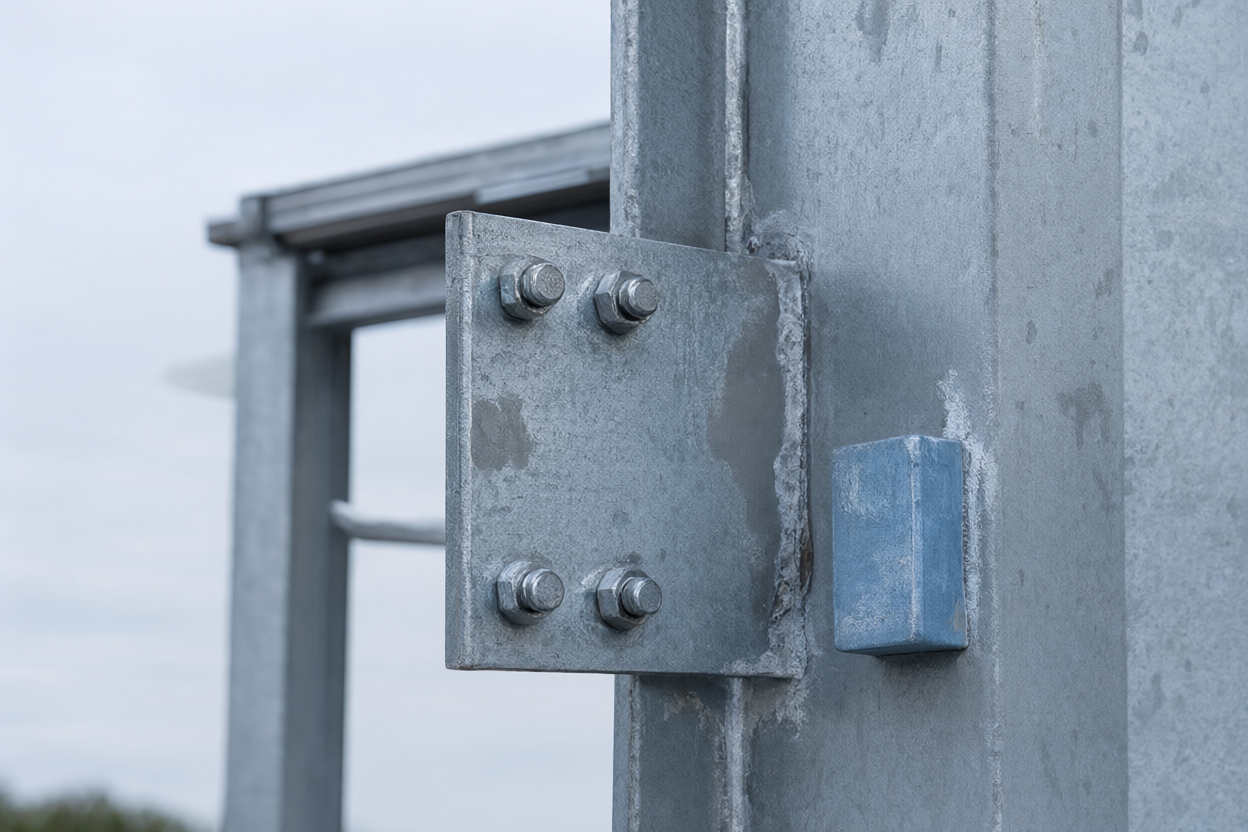
Stainless bolts are often chosen for galvanized steel structures because they resist atmospheric corrosion. In dry inland service this works reasonably well. In wet or coastal service, the zinc coating protects the surrounding steel until the coating is damaged, and then the exposed carbon steel near the stainless fastener corrodes quickly.
Process plants and wash-down areas
Food, beverage and chemical plants combine stainless equipment with carbon steel supports, ladders and frames. Frequent wash-downs supply the electrolyte, and the small stainless component in contact with large carbon steel structures becomes a corrosion accelerator rather than a corrosion-resistant choice.
Roofing and cladding
Stainless or copper flashing in contact with galvanized or carbon steel roofing is a classic failure. Rainwater carries dissolved metal ions and can spread staining well beyond the immediate contact point.
Four Conditions That Turn Contact Into Damage
- An electrolyte: any continuous or repeated film of water, salt spray or condensate.
- Electrical contact: direct metal-to-metal contact, or contact through a conductive path such as a wet fastener.
- Potential difference: the further apart the two metals sit on the galvanic series, the stronger the effect.
- Unfavourable area ratio: a small anodic area against a large cathodic area accelerates penetration.
Remove any one of these four and the reaction slows dramatically or stops.
How to Prevent Galvanic Corrosion
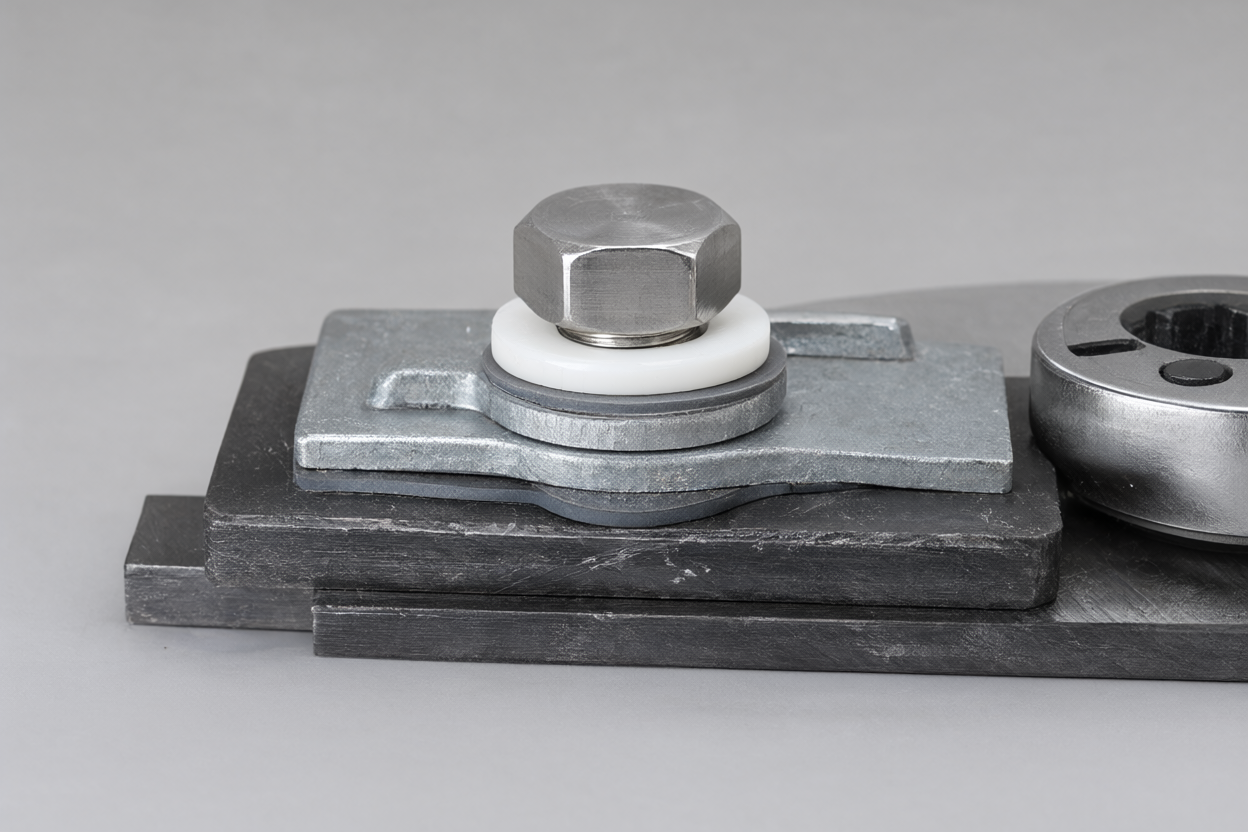
1. Electrically isolate the joint
The most reliable solution is to break the electrical path. Use nylon or neoprene washers under bolt heads and nuts, insulating sleeves through the hole, and gaskets or dielectric tape between dissimilar plates. Isolation kits are inexpensive compared with replacing a corroded connection later.
2. Keep the metals close together on the series
If you must couple dissimilar metals, choose pairs that are close in potential. Galvanized steel next to carbon steel is far more forgiving than stainless steel next to carbon steel, because the zinc coating sacrifices itself and shields the steel beneath.
3. Coat the anodic metal, not just the cathode
Painting the carbon steel is useful, but paint the anodic component carefully and keep the coating intact. A small break in a coating on a large cathode can concentrate attack on the anode. Where possible, coat both members and seal the joint against water ingress.
4. Design for drainage and avoid traps
Water that cannot drain keeps the joint wet. Provide drainage paths, avoid upward-facing crevices and stand-offs that collect water, and keep dissimilar-metal joints out of puddles and splash zones.
5. Use sacrificial anodes where isolation is impossible
In submerged or buried service where perfect isolation is impractical, bolt a sacrificial zinc or aluminium anode to the structure. The anode corrodes in place of the steel and is replaced on a maintenance schedule. This is common practice on marine and offshore structures.
Design and Fabrication Checklist
| Question | Good practice |
|---|---|
| Will the joint stay wet? | Add drainage and avoid crevices |
| Are the metals far apart in the series? | Isolate with washers, sleeves or gaskets |
| Is the anode area small? | Increase contact area or use a closer metal pair |
| Is the joint welded rather than bolted? | Use a matching filler and passivate correctly |
| Is the structure coastal or buried? | Consider a sacrificial anode and scheduled inspection |
FAQ
Does stainless steel rust when it touches carbon steel?
Usually the stainless steel itself does not rust, because it is the cathodic partner. The carbon steel corrodes and its rust can stain the stainless surface, which often looks like stainless corrosion but is really transferred iron contamination.
Can I use stainless bolts in a galvanized structure?
Yes, and it is common practice. In dry or mildly wet service it performs acceptably. In aggressive, coastal or frequently wet service, isolate the bolts or accept that the zinc coating near each bolt will be consumed first.
Does painting stop galvanic corrosion?
Painting slows it but does not eliminate it. The coating must remain continuous. A damaged coating over the anodic member can make localised attack worse, so inspect and repair coatings at dissimilar-metal joints.
Is aluminium on stainless steel worse than carbon steel on stainless steel?
Aluminium sits much lower on the galvanic series than carbon steel, so an aluminium-to-stainless couple in a wet environment is generally more aggressive to the aluminium. The same isolation rules apply, with even more care needed.
Final Buying Advice
Mixed-metal design is a materials question, not a fastener question. Decide early which member will be anodic, then protect that member with isolation, coating, drainage or a sacrificial anode. BaoLi supplies stainless steel sheet, coil and bar, galvanized steel and carbon steel for mixed-metal projects, with export packing and application support. For help matching grades to your environment, use Contact Us.
Related pages: Stainless Steel | Galvanized Steel | Services | Contact Us